
Joan + Bob
the girl who started the boys' club

Bob Dylan and Joan Baez entered my life at the same time, via Dont Look Back. I came to all this late, in college, when my much more culturally with-it peers were probably on Lou Reed obsessions, having gone through the Stages of Bob in their teens. (In one of the most memorable conversations I ever had with a professor, he said, “You discovered Bob Dylan in a class. Most people discovered him over a joint in their parents’ basement.” I didn’t get why it was so funny at the time. Ben Harbert by the way, one of my all-time favs, with a new very relevant book out.)
Anyway, the documentary of Bob’s 1965 tour of England famously captures Bob treating Joan quite cruelly, casting her aside after years of performing with her. It’s seen as a bookend to their storied romance. The problem is—for a 20-ish girl like me very swept up in the genius/allure of 23-ish Bob Dylan —I was not too concerned about Joan Baez’s feelings. She was framed—literally, in many unflattering closeups—as loud, a bit clingy, a bit bossy, and generally uncool from every angle. That is, when juxtaposed against Bob Dylan in leather and shades on the verge of releasing “Like a Rolling Stone.” I challenge anyone to look cool compared to that.
I had basically zero lived experience with poet-musician men like Bob Dylan at the time of meeting Bob Dylan in this film. I grew up with a sister in a pretty feminine world, I’ve realized. Boys were foreign objects for a long time. It was only through dating and being made to feel like a forgettable square in the eyes of some such men that I gained any perspective on Joan’s side of things. It’s an inkling of empathy I’ve tried to expand on through this project. I’m Joan, we’re all Joan, all of us girls who have loved and/or been hurt by the artsy, male-identified people of our time. That’s (secretly) what a Folk Woman is.
In the discussion of how Dylan & Co. left her behind in 1965, Joan has often mentioned that she didn’t/doesn’t do drugs. Sometimes it seems like a weird hang-up of hers, but lately I’ve wondered if it’s at the core of something I need to think more about. Men + drugs is an interesting topic as it intersects with folk music history + gender. As is men + politics, men + clarity of message, men + mystique, men + individualism, men + authority. In a world of growing gender ambiguity and sexual revolution, were drugs a new line in the sand between men and women?
Joan was the original mysterious folk person. Bob took that persona and ran with it to a new level. In the meantime, Joan seems to have reigned that particular way of relating to her audience in, choosing more and more warm directness over cryptic lightbulb-carrying nonsense. I fell so hard for the cryptic lightbulb-carrying nonsense at age 20 first encountering it. It seemed like the answer to all my loneliness and sadness and confusion about life: just keep a good head and always carry a lightbulb. It still seems like the answer. But what the heck? It’s not an answer at all. That’s the whole point. Is this genius or is this a big cop-out or is this a bit of both? What does it have to do with gender? I’d love if anyone wanted to suggest gender theory or other reading to bulk up my thoughts on this.
Did you know Joan published a memoir in 1968??? It’s out of print. I just got a copy. I read the whole thing at a diner downtown yesterday. This passage seems worthy of analysis. Any guesses who it’s about?


I also need to make some sense of how this 1963 “Poem for Joanie” that Bob wrote and published as liner notes to her Grammy-nominated live album Joan Baez in Concert/Part 2 fits in.
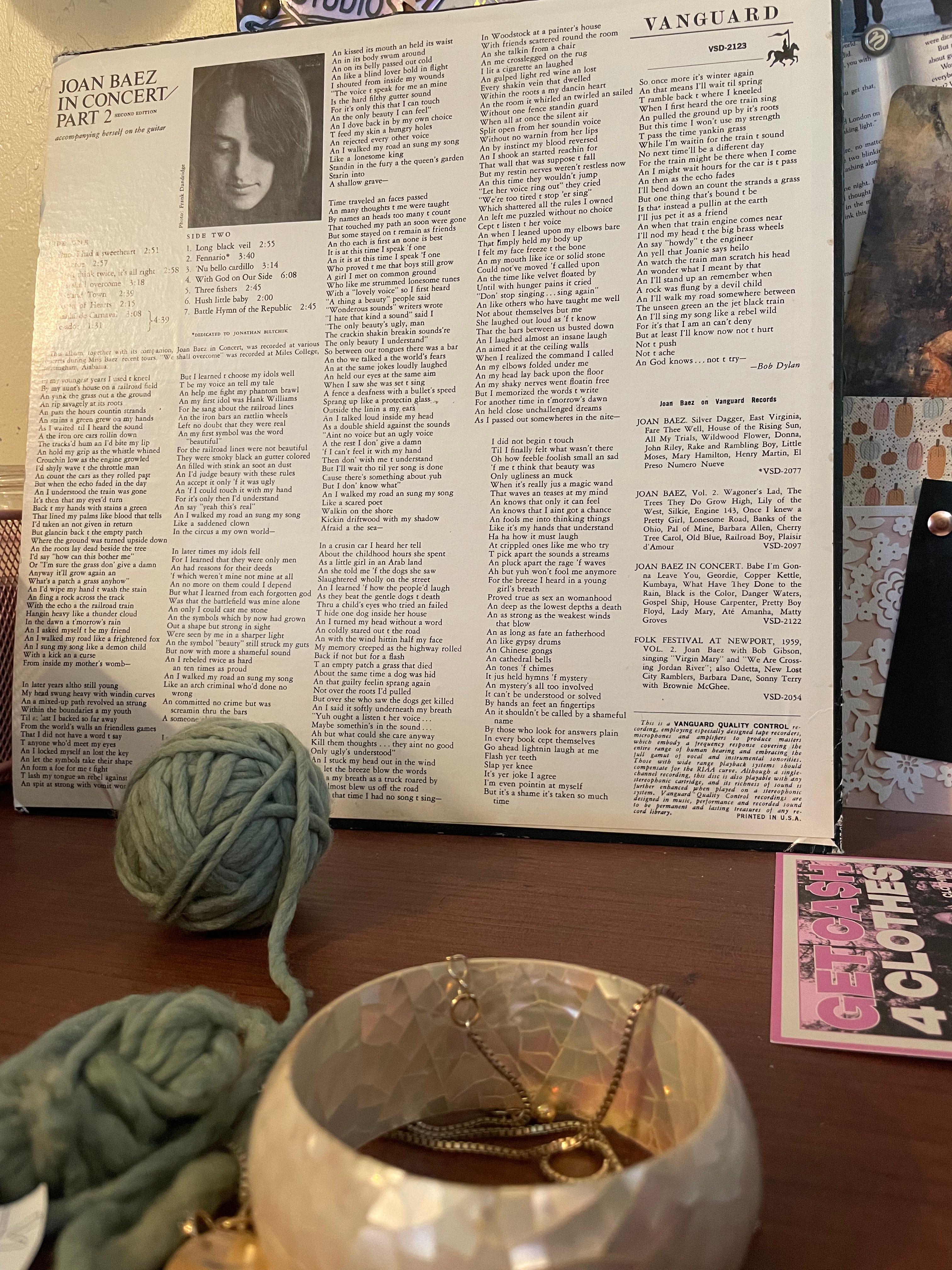
You should be able to click and zoom on this. If intrigued. Cue: rockstar shades.